Ecclesiam res et talia sermocinamur -

We talk about the Church, stuff, and such

Tuesday, April 10, 2007

Fr. Hardon

The Curt Jester passes along a report that the first steps have been taken in the cause of canonization of Fr. John Hardon, SJ. Observant readers will recognize the name from the article I linked in my last post.

The good father's With Us Today: on the Real Presence of Jesus Christ in the Eucharist is one of the most heartfelt books I've read on the subject (and this is no small number, given that reading books on the Eucharist has been my only academic work this semester). As I said in my notes on the work, Fr. Hardon's love for our Eucharistic Lord is obvious. He's quite inspiring.

More information on the cause can be found here.

Labels:

Sunday, January 28, 2007

St. Thomas Aquinas


Today would have been the feast of St. Thomas Aquinas, had he not been bumped by the Fourth Sunday in Ordinary time. Thanks to New Advent, the Summa is all online, as is its sizable biography of the Angelic Doctor.

Labels:

Thursday, January 25, 2007

Conversion of St. Paul

Here's our post, taken from Saint of the Day, for last year's feast of the Conversion of St. Paul

One of the things that always sticks in my mind about this feast is the commentary Fr. Milton Guthrie, for whom my grandmother served as housekeeper for many years, made on the event's popular and artistic conceptions. In a very matter of fact way, he would always comment that it was highly unlikely that Saul had been riding a horse as usually depicted but, rather, that if he had been riding anything, it would have been a donkey.

In some ways, then, there seems to be something even more Catholic, more redeemed, about donkeys than tradition already accepts. The ass finds itself, not only the most absurd and denigrated of all creatures, the most unappreciated and solely utilitarian of beasts of burden, but also the transportation of men such as Saul: petty bureaucrats, tax collectors, the mules of ancient government and society. But just as Saul is approached by God, converted, and redeemed, so too is the donkey. The divine faunal joke is called upon for service, and renders it humbly -- the noble servant has emerged out of a formerly derided creation. His is the story of providence in which all men of faith seek to partake.

Labels:

Thursday, December 28, 2006

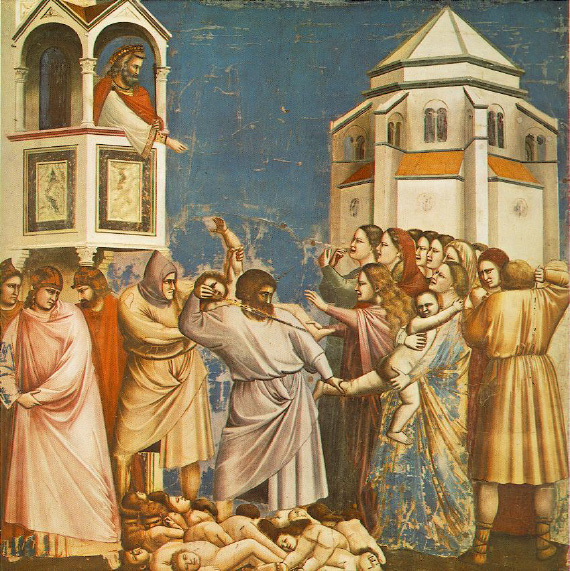
Feast of the Holy Innocents

Matthew 2:13-18

Now when they had departed, behold, an angel of the Lord appeared to Joseph in a dream and said, "Rise, take the Child and His mother, and flee to Egypt, and remain there till I tell you: for Herod is about to search for the Child, to destroy Him." And he rose and took the Child and His mother by night, and departed to Egypt, and remained there until the death of Herod. This was to fulfill what the Lord had spoken by the prophet, "Out of Egypt have I called My Son."

Then Herod, when he saw that he had been tricked by the wise men, was in a furious rage, and he sent and killed all the male children in Bethlehem and in all that region who were two years old or under, according to the time which he had ascertained from the wise men. Then was fulfilled what was spoken by the prophet Jeremiah:

"A voice was heard in Ramah, wailing and loud lamentation:
Rachel weeping for her children;
she refused to be consoled because they were no more."

Labels:

Monday, December 11, 2006

''God Is That Than Which No Greater Can Be Thought''


St. Anselm is featured on the History of Ancient and Medieval Philosophy exam I'll take tomorrow morning, and he is also my special patron for 2007, courtesy of the very dear Moneybags at A Catholic Life.

St. Anselm also sort of makes my brain hurt (see the title of this post for an idea why), so this should make for a fun year. I'm looking forward to getting to know him better in 2007.

Go here to learn more about St. Anselm of Canterbury.

Labels:

Saturday, December 09, 2006

Mary as Mother-in-Law

I’ve had an idea knocking around in my head for a long time, and I just haven’t gotten around to developing it fully enough to warrant a full post. Then I meant to get it up yesterday (it being a Marian feast day and all), but that didn’t happen either. The following is, then, my not-quite-fully-developed musings on Our Lady as a mother-in-law.

Mary is often spoken of as our mother, and this is an apt and beautiful description. I posit, though, that an equally apt (and beautiful, at least if your experiences are like mine) description, if you can momentarily set aside the other, is of Mary as our mother-in-law. The initial argument goes like this: the Church is the bride of Christ. Mary is the mother of Christ. The Bridegroom’s mother is the bride’s mother-in-law. By substitution, Mary is our mother-in-law.

Some people might be tempted to get up in arms over this, what with the general opinion of “mothers-in-law” in our society being quite low. I think, however, that this analogy is a very useful tool for explaining/defending devotion to the Blessed Virgin.

As a way of illustrating*, let me talk about myself, Paul, and his mom: If I want to know something about Paul, I can certainly spend time with and talk to him or read the things he’s written to me. This is, obviously, the best way to build our relationship. But why limit myself to only that way, even if it is the best, if there are other good ways? Paul’s mom, by virtue of being his mother, knows things about him that he might not ever think to tell me or I might not even think to ask. She has a bond with him that I’m not able fully to understand (and likely won't be until I have children of my own). By spending time with and cultivating a relationship with her, I can strengthen my relationship with her son. He’s also pleased when she and I get along well. He loves us both, so he wants us to be friends. Finally, if ever there were something that I really wanted or needed him to do and I needed help in asking him for it, whose help could be better to enlist? He can’t possibly say no to both of us.

What would make one think that it could be any different with Jesus and His mother? Wouldn’t He be just as pleased for the Christian—whom He takes as His bride—to love and honor His mother as Paul is? Of course He is. Doesn’t He feel as compelled to do as she asks Him? From the Wedding at Cana, we know that He does.

It seems obvious that any person’s mother is the first to love him. Just like my future mother-in-law was the first to love Paul, Mary was the first person to love the Incarnate God. One must recognize that her mother-in-law has much to teach her about loving her husband, and in the same way, we must see that Mary has much to teach us about loving Jesus.

*Bear in mind, this is meant only to be an illustration—a picture to help us grasp larger and deeper ideas. I don’t want anyone to think I’m equating Paul and his mom with Our Lord and the Blessed Virgin, or anything like that.

Labels: